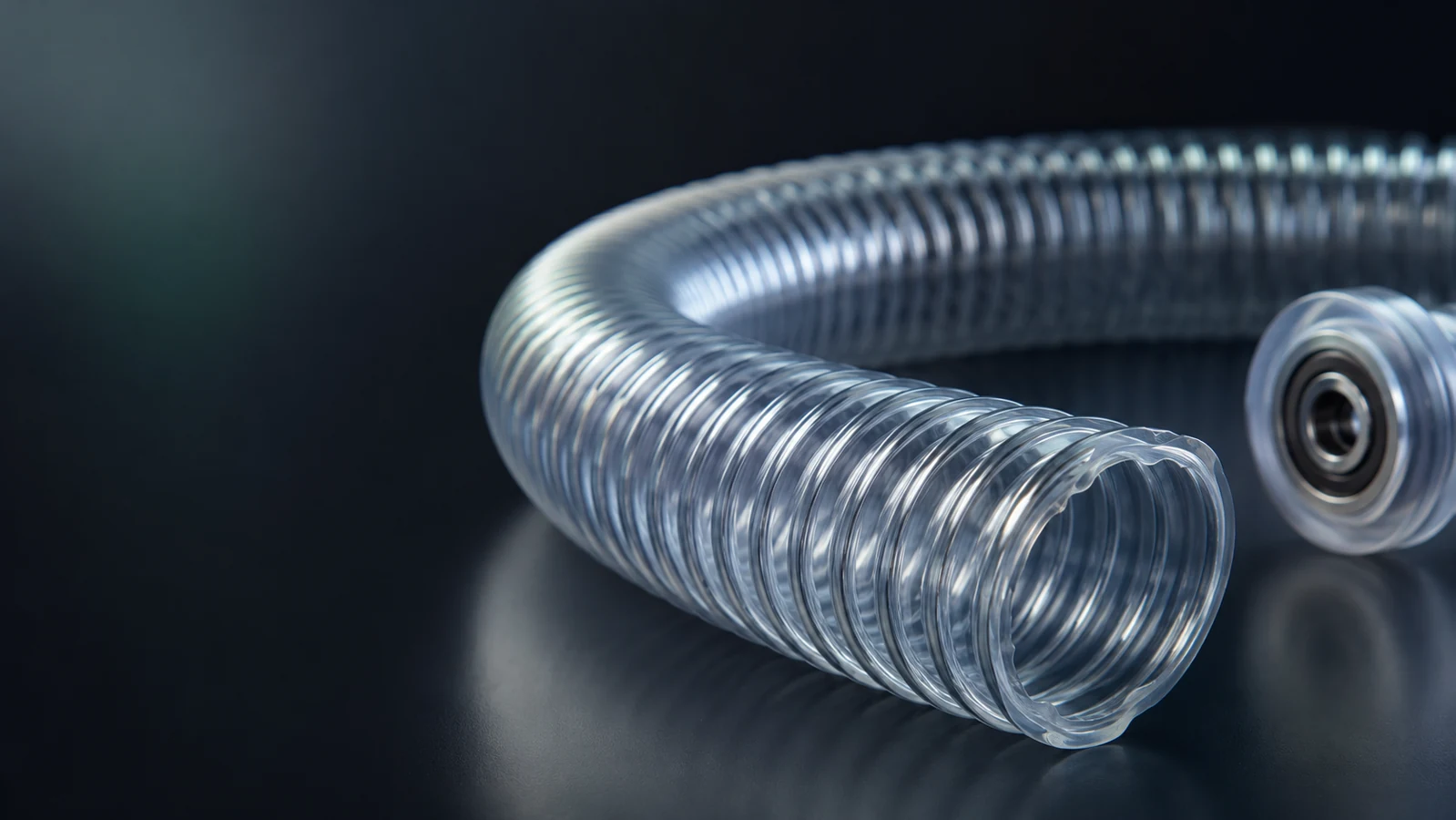
Exaflex® TPU — thermoplastic polyurethane: grades 80A–65D, properties, processing, TDS

Exaflex® TPU — Thermoplastic Polyurethanes | Material Wizard
Engineering thermoplastic polyurethanes

Exaflex® TPU — engineering thermoplastic polyurethanes for resilient, wear-resistant, and dynamically loaded parts

Exaflex® TPU is a range of thermoplastic polyurethanes for parts that require elastic deformation, abrasion resistance, shape stability after repeated cycles, and series processing by injection molding or extrusion without vulcanization.

80A–95A soft, medium-hard, and hard Shore A grades 55D–65D rigid TPU grades Injection molding / extrusion series processing
36mm³ abrasion loss for 80A–90A
ASTM D5963
>600% elongation for 95A
ASTM D412
200kN/m tear strength
for TPU 65D
<0.02%target moisture content before
processing
Quick engineering takeaway

When Exaflex® TPU should already be considered at the material selection stage

Exaflex® TPU is worth considering for parts where elastic performance is combined with friction, impact, bending, contact with technical fluids, and series processing requirements. The first level of screening is not the material's general properties, but the operating mode of the specific part.

Moving or wear-resistant part

Rollers, wheels, bushings, guides, friction elements, parts with repeated contact. Abrasion, heat generation in the contact zone, and profile retention after load cycles are critical.

Flexibility without vulcanization

The part must perform like an elastomer but be manufactured as a thermoplastic: injection molding, extrusion, reprocessing of clean production scrap.

Contact with oils and greases

Polyester-based TPU is well suited for applications requiring mechanical durability and resistance to many mineral oils, greases, and technical media.

Stable series production

TPU selection accounts for part geometry, drying, temperature profile, melt flow, shrinkage, cycle repeatability, and the risk of moisture-related defects.

Interactive comparison

TPU compared with other thermoplastic elastomers

This block does not show the "best material overall". It compares the engineering profiles of TPU, TPV, TPE-S, TPO, TPEE, and PEBA against clear criteria: wear, tear, shape recovery, oils, moisture, heat, cold, processing, and cost efficiency.

Property radar

higher = stronger position
How to read the comparison. TPEE and PEBA often outperform TPU in highly technical applications, especially in temperature stability, low-temperature performance, fatigue dynamics, or premium resilience. TPU's strong zone is high wear resistance, tensile strength, oil resistance, straightforward series processing, and a more rational cost for high-volume technical parts.
Engineering selection logic

What Shore 80A, 95A, 55D, or 65D actually means

TPU hardness is assessed together with the design of the product. The same Shore value performs differently in a part depending on wall thickness, rib geometry, service temperature, deformation rate, contact with grease, and processing conditions.

In the soft Shore A zone, the material provides elasticity, impact damping, and high elongation. In the hard Shore D zone, TPU approaches structural thermoplastics, yet retains tougher impact behavior than many conventional rigid plastics.

For correct selection, hardness should be considered together with the part's function: sealing, bending, abrasion, loading, hose service, or edge retention after repeated cycles.

The Exaflex® TPU range by hardness

A pre-selection map: from elastic grades for rollers, seals, and hoses to rigid TPUs for parts with a higher modulus.

80A
83A
85A
90A
95A
55D
65D
80A–95A: elastic parts, rollers, seals, cable jackets, hoses, footwear components.
55D–65D: rigid TPUs for parts requiring high strength, tear strength, and lower deformation under load.

Exaflex® TPU product range

TPU grades in the Material Wizard range

The table is intended for preliminary technical screening: it shows the differences between grades, the key comparison parameters, and the role of the technical data sheet for the design or process engineer.

Grade Hardness Density Melt flow rate Strength / elongation Abrasion Typical application area Grade page
Exaflex® TPU 80A
elastic
80 Shore A 1.21 g/cm³ 30
200°C / 5 kg
32 MPa / 550% 36 mm³
ASTM D5963
Rollers, flexible parts, footwear elements, seals, shock-absorbing components. Go to grade
Exaflex® TPU 83A
versatile
83 Shore A 1.21 g/cm³ 30
200°C / 5 kg
32 MPa / 550% 36 mm³ Injection molding and extrusion, parts of medium elasticity, seals, technical products. Go to grade
Exaflex® TPU 85A
medium hardness
85 Shore A 1.21 g/cm³ 30
200°C / 5 kg
32 MPa / 550% 36 mm³ Technical elastic parts requiring slightly higher hardness without loss of elongation. Go to grade
Exaflex® TPU 90A
increased hardness
90 Shore A 1.23 g/cm³ 50 cm³/10 min
200°C / 5 kg
37 MPa / 648% 36 mm³ Hoses, profiles, cable jackets, parts with higher surface hardness. Go to grade
Exaflex® TPU 95A
hard Shore A
95 Shore A
23 Shore D
42 MPa / 572% Wear-resistant profiles, linings, industrial rollers, hydraulic hoses, protective profiles, and parts with high elastic rebound. Go to grade
Exaflex® TPU 55D
rigid TPU
55 Shore D 1.21 g/cm³ 52 MPa / 280% 95 mm³ More rigid technical parts, sports components, seals with increased load-bearing capacity. Go to grade
Exaflex® TPU 65D
maximum rigidity
65 Shore D 1.21 g/cm³ 55 MPa / 250% 65 mm³ Rigid TPU components requiring strength, tear strength, and a shorter molding cycle. Go to grade

Grade pages linking to the product cards:

Grade selection

Selecting TPU by the part's operating mode

For a production part, Shore A/D hardness is only a starting parameter. The decision is made on the full set of factors: deformation mode, wall thickness, contact with fluids, abrasion, temperature, cycle requirements, and drying before processing.

If the main risk is softness and shape recovery

Start with 80A–85A. These grades deliver high elongation, good abrasion resistance, and better performance in parts that must flex, compress, or damp impact.

80A / 83A / 85A

If a dense elastic surface is required

Check 90A–95A. This is the zone for profiles, hoses, sheathing, roller and technical elements where deformation must be lower while an elastomeric nature is still required.

90A / 95A

If the part is closer to an engineering plastic

Consider 55D–65D. In this zone, the key factors are strength, tear strength, stiffness, and lower deformation under load.

55D / 65D
To replace a specific grade of BASF Elastollan, Covestro Desmopan, Lubrizol Estane, or another TPU, you need to compare Shore A/D hardness, stress at 100/300% elongation, tear strength, abrasion, melt flow, polyol backbone type, processing temperature, and the behavior of the finished part after conditioning.
Applications

Where TPU delivers a practical advantage

The examples below reflect real-world part operating scenarios where TPU properties directly affect service life and product consistency.

Rollers, wheels, guides

Require abrasion resistance, impact damping, resilience, and a stable contact surface after repeated cycles.

80A–95A
Seals and gaskets

Key factors are an elastic fit, tear strength, performance under compression, and contact with greases or technical fluids.

80A–90A
Hoses, tubing, profiles

Extrusion processing, kink resistance, wall control, and sufficient melt flow for a stable profile.

90A / 95A
Cable jacketing

Flexibility, wear resistance, resistance to friction against surfaces, clean extrusion, and the ability to perform under dynamic conditions.

85A–95A
Footwear components

Require resilience, wear resistance, a stable molding cycle, surface aesthetics, and batch-to-batch repeatability.

80A–85A
Rigid technical parts

When a conventional elastomer is too soft, and a rigid plastic is too brittle or handles impact loads poorly.

55D / 65D
Application limits

Where TPU is not the best first choice

TPU should be viewed as an engineering elastomer with a wide property range, not as a universal replacement for all elastomers or engineering plastics. At the selection stage, consider the grade's chemistry, temperature profile, environmental humidity, long-term dimensional requirements, and aging conditions.

01

Prolonged service in hot water or humid environments

For ester-based TPUs, hydrolytic degradation can become critical when elevated temperature and humidity combine. For such applications, consider ether-based or specially stabilized grades and verify service life in the actual environment.

02

Harsh outdoor service without stabilization

Aromatic TPUs can discolor under UV radiation. If the part operates outdoors or must retain transparency/color, aliphatic, light-stabilized, or pigmented solutions are required.

03

High static loads and tight tolerances

When a part must hold its shape under constant load for a long time, TPU falls short of rigid engineering plastics. For housings, load-bearing brackets, and precision fits, PA, PBT, POM, PPA, or reinforced materials are often the more logical choice.

04

Contact with aggressive solvents or unknown chemicals

TPU performs well in many oils, greases, and technical media, but compatibility with solvents, plasticizers, acids, alkalis, and cleaning agents must be confirmed by testing the specific grade.

Processing

TPU processing: drying, melt temperature, and moisture control

Stable TPU processing requires control of pellet moisture, the temperature profile, melt residence time in the barrel, and cooling conditions. Insufficient drying can cause bubbles, splay marks, degraded mechanical properties, and unstable surface quality.

1

Drying before processing

Recommended: 90–100°C for 3–4 hours in a circulating-air or desiccant dryer. Target moisture content is below 0.02% before and during processing.

2

Injection molding

For 80A–95A, a typical zone profile is around 175–200°C; for 55D, 180–210°C; for 65D, 190–220°C. The actual profile is adjusted to the machine, part geometry, and melt residence time.

3

Extrusion

For most grades, the technical data sheet specifies an extrusion window of approximately 180–200°C with a die around 190–195°C. A stable profile depends not only on temperatures but also on pressure, cooling, haul-off speed, and calibration.

4

Reprocessing

Clean, well-sorted production scrap can be reused after drying and verification of property stability. Blending different TPUs requires a compatibility check.

Grade Injection molding, °C Extrusion, °C Drying Process engineer's note
55D180 / 185 / 190 / 195 / 200 / 205 / 210185 / 190 / 195 / 200 / 19590–100°C, 3–4 hRigid grade: monitor the filling of thin sections and the risk of residual stresses.
65D190 / 195 / 200 / 205 / 210 / 215 / 220185 / 190 / 195 / 200 / 19590–100°C, 3–4 hHigher processing temperature; controlling residence time in the barrel is important.
80A175 / 180 / 185 / 190 / 195 / 200 / 200185 / 190 / 195 / 200 / 19590–100°C, 3–4 hA good starting grade for elastic technical parts.
83A / 85A175 / 180 / 185 / 190 / 195 / 195 / 190180 / 185 / 190 / 195 / 19090–100°C, 3–4 hA versatile zone between softness and shape stability.
90A175 / 180 / 185 / 190 / 195 / 195 / 190180 / 185 / 190 / 195 / 19090–100°C, 3–4 hA grade for profiles, hoses, and denser elastic parts.
95A185 / 190 / 195 / 200 / 195180 / 185 / 190 / 195 / 20080–100°C, 2–3 hHard Shore A grade: high modulus, elastic rebound, mandatory drying to a moisture content below 0.02%.
Technical limitations

Areas that require separate verification

TPU must be matched to the specific assembly, load mode, service environment, and processing technology.

Hydrolysis and water

Ester-based TPU offers a high mechanical performance level and good oil resistance; however, prolonged contact with hot water, steam, or microbiologically active environments requires separate verification of hydrolytic stability.

Creep under load

For parts that operate under constant compression or tension for long periods, verify compression set, creep, and shape recovery after repeated cycles.

Adhesion, painting, welding

For multi-material products, TPU compatibility with the second material, primer, paint, adhesive, or welding method is critical. Shore hardness alone does not guarantee it.

Material Wizard

Technical TPU selection for the part's operating conditions

Material Wizard selects engineering polymers based on part design, load mode, and processing technology. For Exaflex® TPU, it is important to assess flexing, abrasion, oil contact, hose service, repeated impact, sliding, sealing, or thin-wall molding.

For fast selection, please specify the processing method, Shore A/D hardness, wall thickness, operating temperature, contact media, required cycle life, and the current material to be replaced.

What to send for fast selection

  • A photo or drawing of the part, if the geometry can be shown.
  • The current material or the TPU grade to be replaced.
  • Shore A/D hardness or the desired stiffness feel.
  • Processing method: injection molding, extrusion, two-component molding, profile.
  • Service environment: water, oil, fuel, friction, UV, temperature.
  • Estimated monthly volume or a starting trial batch.
FAQ
FAQ

Questions to answer before launching TPU into production

Can you simply take a TPU with the same Shore hardness as a competitor grade?

That is only an initial filter. A technical replacement requires comparing tensile strength, elongation at break, tear strength, abrasion, melt flow, polyol backbone type, processing temperature, and the actual behavior in the finished part.

Why is drying so important for TPU?

TPU is moisture-sensitive. Insufficiently dried material can cause surface defects, bubbles, unstable mechanical properties, and poor cycle repeatability. For Exaflex®, the technical data sheets specify a target moisture content below 0.02%.

Which is better: 80A, 85A, or 95A?

80A suits softer, resilient parts; 85A covers the intermediate zone between resilience and shape stability; 90A gives a denser surface and lower deformation; 95A is for hard Shore A parts, wear-resistant profiles, rollers, and elements with high elastic rebound.

Is Exaflex® TPU suitable for extrusion?

Yes, the technical data sheets for Exaflex® TPU grades include parameters for both injection molding and extrusion. Stable extrusion additionally requires fine-tuning the melt temperature, calibration, cooling, and haul-off speed.

Can regrind or production returns be used?

Clean, well-sorted production scrap can be tested, but it must be dried and its property stability monitored. Blending different TPUs without verification is not recommended.

Exaflex® TPU selection

Send us your technical requirements — we will select an Exaflex® TPU grade

Describe the part, operating conditions, processing method, and desired Shore A/D hardness. We will help narrow the choice down to 1–2 grades and send a technical data sheet for trials.

Phone+38 050 323 23 21
Websitematerialwizard.com.ua