Товары и услуги
Exablend® POK GF50 S4 — High-Stiffness Polyketone with 50% Glass Fiber
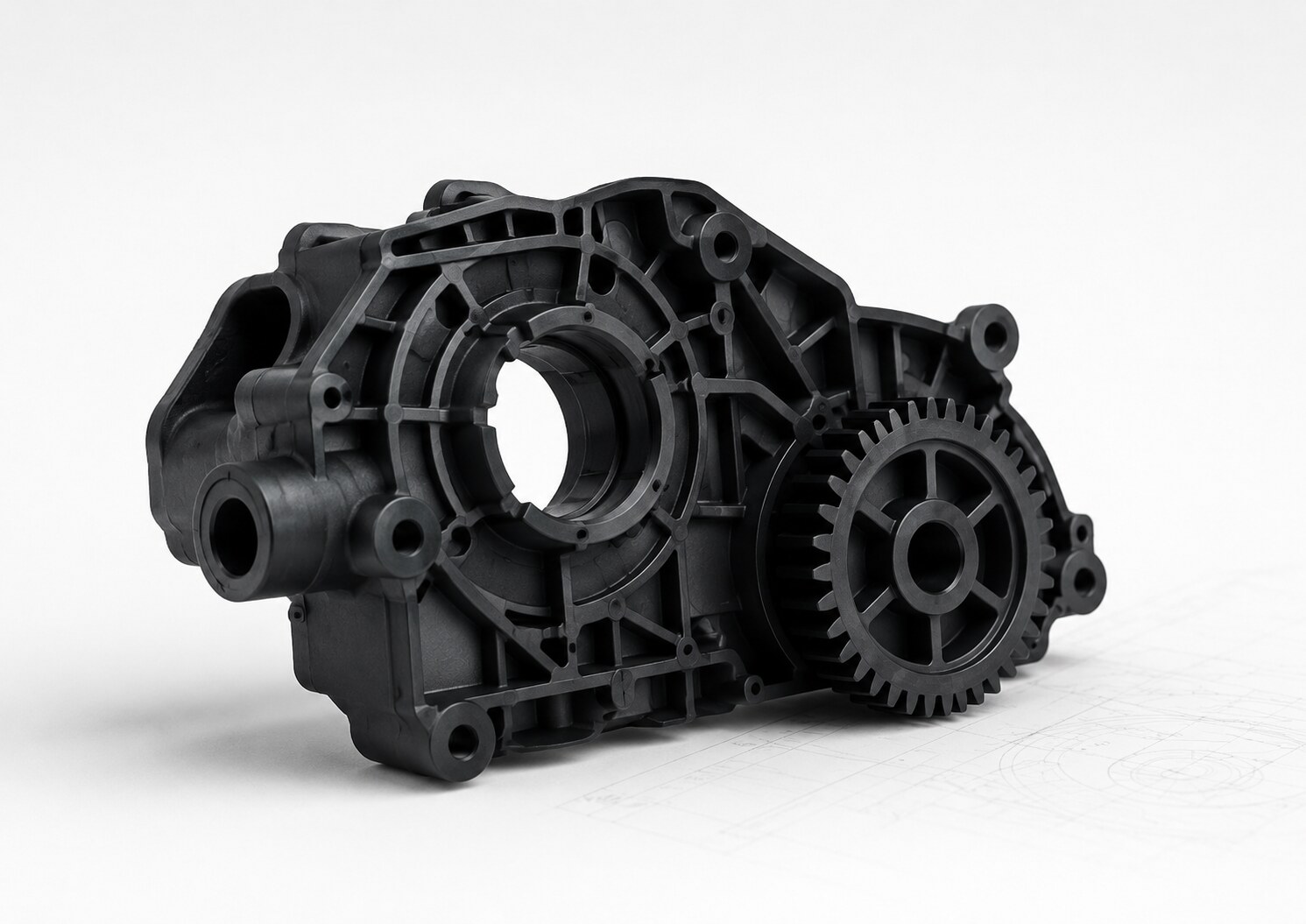
Exablend® POK GF50 S4 is a glass-filled compound based on polyketone,
developed for precise structural parts that require high stiffness,
low shrinkage, stable geometry after molding and reliable performance in technical environments.
The material combines the stiffness of a reinforced compound with the characteristic advantages of POK:
low water absorption, chemical resistance, wear resistance and stability in assemblies
where load, friction, temperature, fuel, oils or moisture act simultaneously.
POK GF50 S4 should be viewed not as a universal “strong plastic” but as a material for
parts in which stiffness and geometric accuracy must be maintained not only after molding
but also in service. The high glass fiber content produces a tensile modulus
of up to 17 000 MPa, while the polyketone matrix adds stability in environments
where standard PA, POM or PBT may have limitations.
The material performs best where the design simultaneously demands a high modulus,
low shrinkage, chemical resistance, stable fits and predictable serial processing.
The main physical-mechanical, thermal and processing characteristics of the material are given
in the table below. For a correct assessment of the grade it is important to analyze not a single value
but the full set of parameters: modulus, strength, impact strength, shrinkage, HDT and the material's
behavior under real service conditions.
The material is intended for injection molding. For POK GF50 S4 it is important to control
the melt temperature, residence time in the barrel, drying quality and mold filling.
Because of the high glass fiber content, the abrasive effect on tooling, fiber orientation
and possible anisotropy of properties in the finished part should be taken into account.
The temperature profile, drying parameters, injection pressure and recommended processing modes
are best placed in a separate WordPress table to keep the page readable and avoid
overloading the main description.
For POK GF50 S4 parts, it is advisable to account at the design stage for the flow direction,
glass fiber orientation, the difference in shrinkage along and across the flow, weld line locations,
wall thickness uniformity and the actual conditions of contact with fuel, oils, moisture or
industrial chemicals.
The material delivers its best results when the grade, part geometry, mold and molding parameters
are treated as a single engineering system.
Exablend® POK GF50 S4 — High-Stiffness Polyketone with 50% Glass Fiber
Engineering rationale of the grade
Typical applications
Key advantages of Exablend® POK GF50 S4
Technical characteristics
Processing recommendations
Design considerations