
Blog
Analysis of Polyamide Use in the Production of Tactical Tourniquets
Introduction
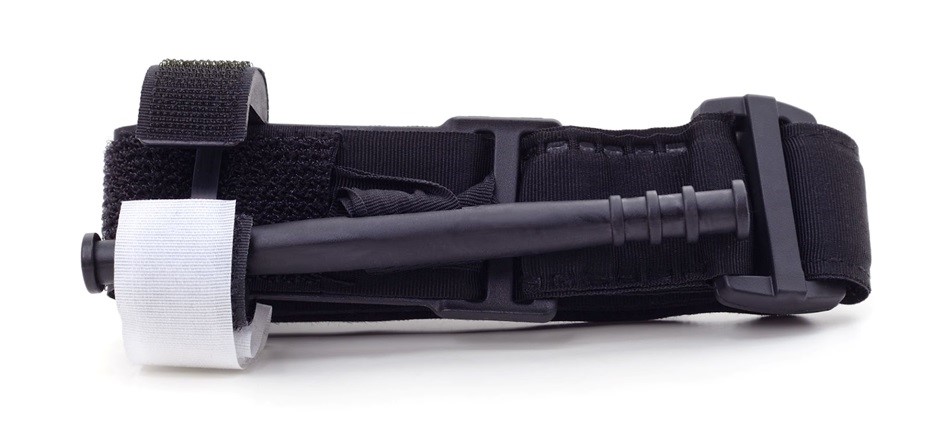
In recent years, the world has witnessed a growing number of conflict situations, which have led to a significant increase in demand for tactical medicine supplies. In this context, tactical tourniquets have become an essential first-aid tool on the battlefield, especially amid the Russian invasion of Ukraine. The production of effective and reliable tourniquets has become a matter on which human lives depend. Organizing tourniquet production in Ukraine is a highly urgent task aimed at eliminating the logistical difficulties of delivery from abroad, covering the shortage of these products, and providing the military, rescue services, and the civilian population as a whole with affordable, high-quality tourniquets. The history of tourniquets dates back to the Middle Ages, but only recent technological advances have created the conditions needed for their improvement. Among the materials used in their production, polyamides (PA) hold a special place thanks to their strength and flexibility. However, the development of tourniquets capable of withstanding extreme conditions and providing reliable aid has faced serious challenges in materials science.
Key tourniquet components and product problems
Two components play a key role in tourniquet performance (apart from the nylon strap, which we do not cover in this review): the windlass and the buckle, both produced by injection molding. The windlass transmits the tightening force, while the buckle securely fixes the device on the casualty's limb.
The main difficulties faced by manufacturers relying on reverse engineering are related to the choice of polymer material. The readily available PA6, PA66, and ABS grades familiar to process engineers often exhibit brittleness, excessive flexibility, unstable strength properties, uninformative stiffness, and non-plastic fracture. Such properties are unacceptable for tourniquets, on whose reliability human life depends.
Many companies that had started manufacturing tactical tourniquets approached us, and all of them had run into the difficulties described above. A suboptimal polymer choice was quite typical, and the cause was often a lack of information about the required material performance and a failure to account for how material properties change over time.
If the unsuitability of ABS plastic is obvious because of its low physical and mechanical properties, why do problems arise with polyamides, which are considered strong polymers?
The most common materials in Ukraine are general-purpose PA6 and PA66 grades, particularly glass-filled ones. Unlike American tactical tourniquets made from expensive high-performance polyamides with enhanced reliability, these general-purpose polyamides are not always the best solution. The issue lies in the effect of moisture absorption.
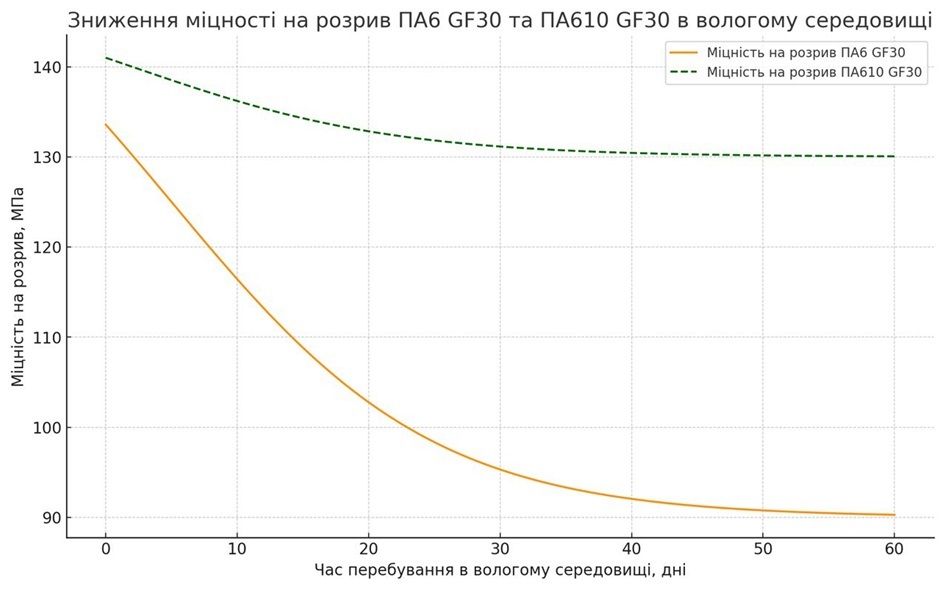
Material Wizard recommends taking into account the behavior of common PA6 and PA66 grades, notionally modeled in the following graphs:
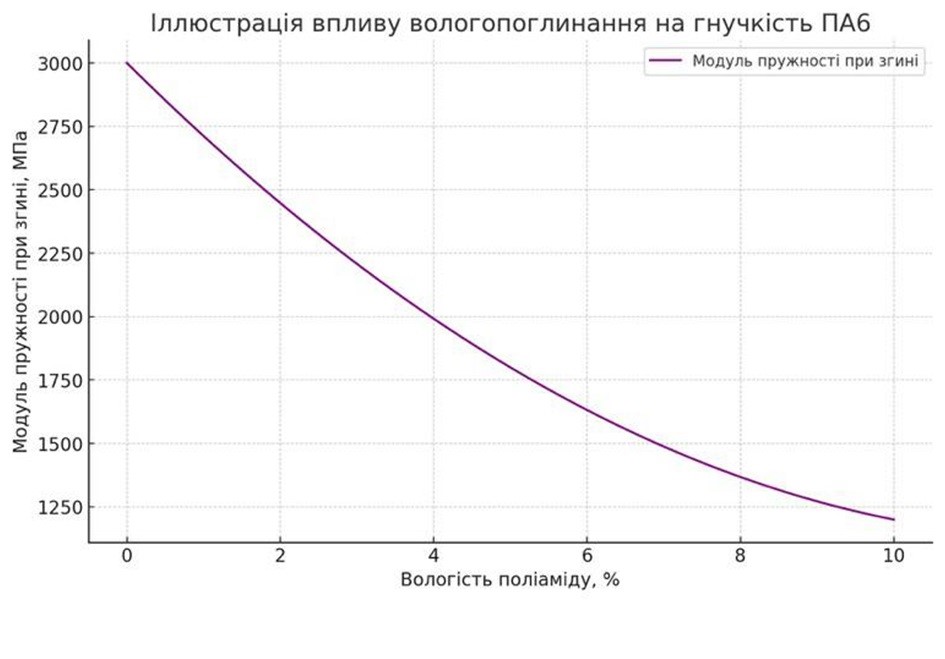 A polyamide can lose 60-70% of its stiffness due to moisture absorption alone, which typically takes place within 1-3 months.
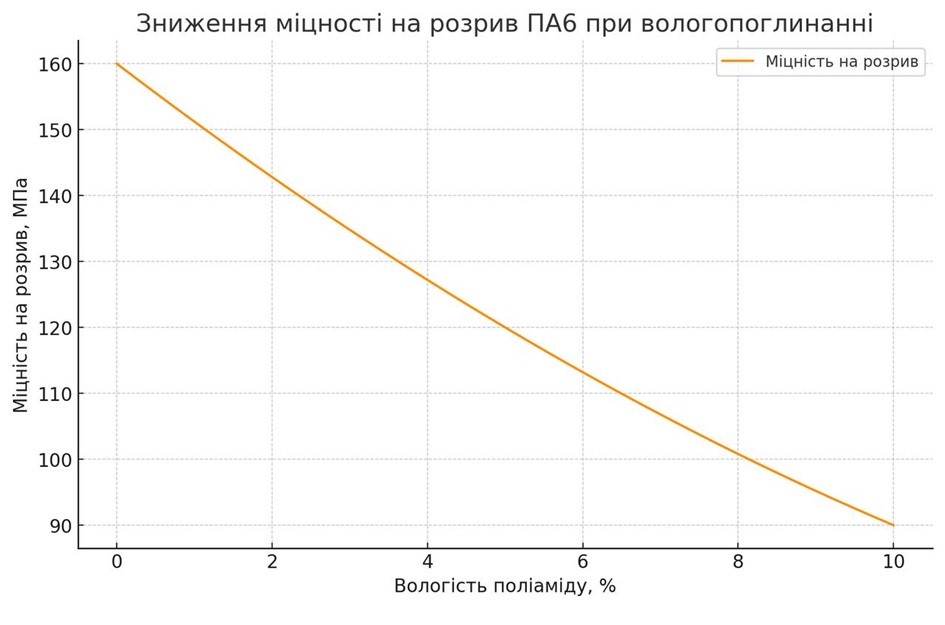 Moisture absorption reduces tensile strength. The negative effect may appear a month after molding.
Let us review the polyamide grades used in Ukraine and the problems manufacturers face.
Review of polyamides for selecting the tourniquet windlass material.
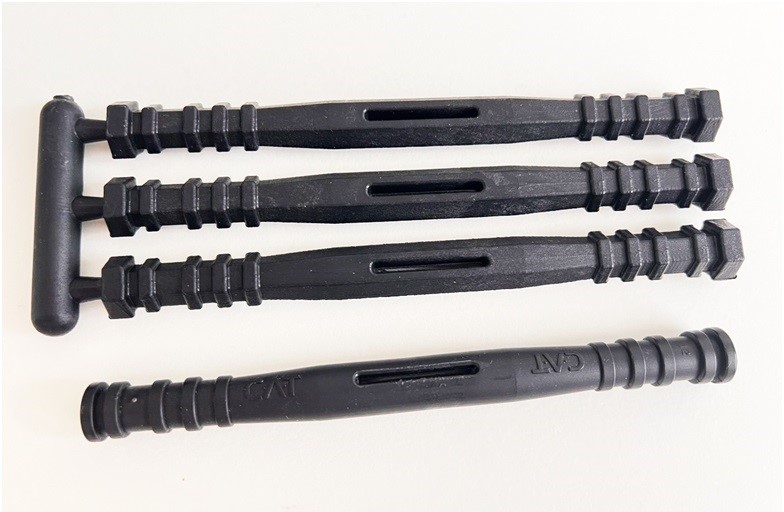
Unfilled PA6 and PA66
Drawbacks:
- high crystallinity, dependence on molding parameters and, as a result, brittleness
- brittleness in freezing conditions. The defect most often appears only in winter, when the plastic lacks low-temperature resistance. Standard unmodified grades are used, which become stiffer at sub-zero temperatures but also more brittle. Note how sharply the elastic properties of polyamide can drop as the temperature decreases.
- high flexibility and a low elastic modulus are also a problem. When tightened, the windlass starts to flex and fails to deliver the tightening force.
- instability caused by moisture absorption. Within 2-3 months, the part can lose 60-70% of its tensile strength and stiffness due to moisture saturation of the polyamide. Most manufacturers overlook this aspect. Ignorance of the properties of moisture-saturated polyamide can lead to designing a tourniquet that is inoperable in combat conditions.
PA6 glass-filled 30%, PA66 GF30
A good material for a tourniquet, but there are nuances here as well
The risk factors are:
- reduced strength in freezing conditions
- unpredictable failure of the windlass, with a crystalline, fragmenting fracture pattern.
We have received reports of windlass failure under strong tightening. Because of the material's stiffness, it is impossible to tell that the stress limit has been exceeded, and a medic may apply enough force to break the part. The consequences of the failure of a tourniquet meant to save lives can be both tragic and catastrophic.
Quality PA6 GF30 grades such as Durethan BKV 30 and Examid PA6 GF30 are a good choice for a tactical tourniquet and retain a large strength margin even at high moisture absorption. For even greater reliability, we recommend using improved low-temperature-resistant modifications of PA6 GF30.
PA6 glass-filled 50%, PA66 GF50
An even more reliable and stronger polyamide. Its only drawback is high weight. The fracture pattern of the windlass is predicted to be crystalline, but no failures have occurred thanks to its very high tensile and flexural strength.
Carbon-fiber-filled PA6
A very stiff, strong material. It offers the advantages of PA6 GF50, and the finished part is significantly lighter. It costs several times more than glass-filled PA and is used for the premium segment.
High-performance polyamides
PA 12 GF 50. Inherent low-temperature resistance, high stiffness and impact strength, stable properties, and extremely low moisture absorption. An excellent choice, but the highest price. The material's properties substantially exceed the product requirements. Another excellent material is PA610 GF30. Long-term high reliability. Its downside is the price. The material's properties are well above the requirements for the windlass.
The optimal solution. Conclusion
The best choice for the windlass is glass-filled polyamide. The safest option in every respect at a moderate price is the modified grade Examid 6 GF30 62100i. While stiff and strong, this material features an additional impact-resistant and low-temperature-resistant modification that reduces the probability of tourniquet failure to zero. Where additional, even higher reliability requirements apply, we recommend PA610 GF30 and PA 12 GF50.
Review of Polyamides for Buckles
The buckle-related issues are similar, with the addition of specific difficulties linked to their function. It is important that the buckle material offers not only high tensile strength but also property stability under moisture absorption and temperature fluctuations.
Drawbacks of buckles made from unfilled polyamide 6 and polyamide 66 grades.
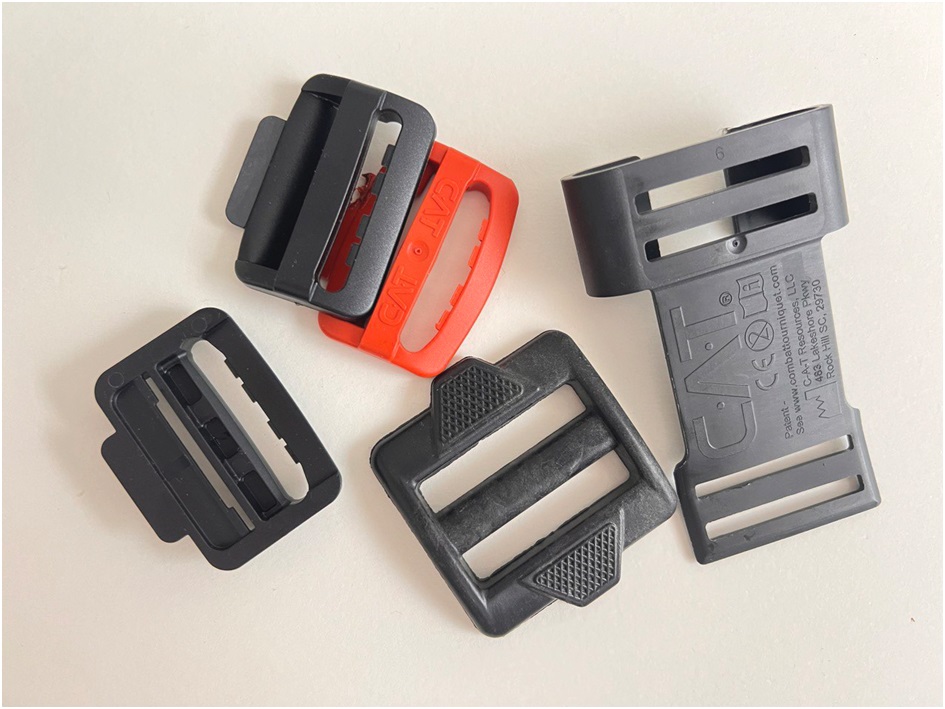
PA6 and PA66 are common but unreliable buckle materials. The reason is the uncontrolled change of properties caused by the material's moisture absorption. Tensile strength studies showed a range of 500-900 MPa, whereas a CAT buckle withstands 1000 kg. A particular problem is that a buckle defect may not show up immediately. If a dry, freshly molded part is tested, it may show higher strength, but over time this figure will decline, and by the time of use the tensile strength values may drop by 50-60%, while ductility increases, so that when the tourniquet is tightened the buckle may simply bend.
There is a solution to this problem, but it is fairly expensive - switching to high-performance polyamides of the following family:
PA12
PA1010
PA610
PA612
The materials on this list have extremely low moisture absorption, which has a positive effect on the stability of strength and dimensions. Properly selected modifications of these materials are highly resilient, and the part is practically impossible to break. Modified Examid PA 610/PA 612 matches the IR spectrum of the CAT tactical tourniquet. Tensile strength tests of the buckles showed 1050-1100 MPa, exceeding the American parameters. This polymer is the best choice for a tourniquet buckle.
Drawbacks of buckles made from glass-filled polyamides
Glass-filled PA6 GF30 has a substantially higher tensile strength, and stretching the buckle to the breaking point seems impossible, yet it can happen - and during tightening it is impossible to notice that the part is already under critical loads. It is important to understand that accounting for load distribution based only on flexural and tensile strength, while ignoring the low elongation at break of glass-filled polyamide, can be a mistake. A part made from unfilled polymers with high elongation and stable stiffness performs its functions significantly better, since the load is distributed across tensile, bending, torsional, and compressive deformation, making the fullest use of the polyamide's entire set of strength properties.
Conclusion. Ultra-High performance polyamides as the solution for the tourniquet buckle:
High-performance polymers such as PA 12, PA 610, and PA 612 demonstrate substantial advantages thanks to their low moisture absorption, high low-temperature resistance, and impact strength. Their use makes it possible to achieve the required performance characteristics of buckles, ensuring tourniquet reliability in a variety of conditions.
General Conclusion
Material selection plays a key role in the design and production of hemostatic tourniquets. The price of a reliable tourniquet is a life saved. Modern research and development in the field of polymer materials opens up new opportunities for improving tourniquet performance. An important criterion is the stability of the tactical tourniquet's parameters throughout its service life, regardless of environmental conditions. Modified polyamides, such as glass-filled Examid PA6 GF30 62100i and high-performance PA 12 and PA610, offer an optimal combination of stability, strength, impact resistance, and low-temperature resistance, making them an ideal choice for the production of reliable and effective hemostatic tourniquets capable of saving lives in the most extreme conditions.