
Carbon-fiber-filled polyamides:
the engineering logic of PA CF selection
An engineering article for process engineers, design engineers, R&D specialists and technical buyers who evaluate PA CF not by its name, but by its behavior in a real part.
A carbon-fiber-filled polyamide should not be seen as a more expensive and automatically stronger version of PA GF. In a real part, PA CF works as a system in which the result is determined by the matrix, the type and length of the carbon fiber, the quality of the interphase, fiber orientation during molding, part geometry, contact with metals and the economics of series production.
The CF30 designation is not a complete technical description. Two PA66 CF30 grades can have different flow, different residual fiber length after compounding, different fiber surface treatment, different stabilization and different behavior in the weld line zone.
Why the same CF30 can behave differently
CF30 only indicates the approximate carbon fiber content. It does not describe the full structure of the material and does not predict how the part will behave in a specific mold. In practice, the outcome is affected by the molecular weight of the polyamide matrix, melt viscosity, fiber type, residual fiber length after extrusion, fiber surface treatment, the level of interfacial adhesion, dispersion, stabilization and the molding process window.
The interphase often determines whether the carbon fiber will actually work as a reinforcing element. If load is transferred poorly from the matrix to the fiber, a high CF content does not guarantee the expected gain in properties. Scientific studies of PA6/CF show that fiber type, surface treatment, length and orientation have a marked effect on the mechanical result.
For Material Wizard this is a matter of principle. We do not select PA CF by grade name or filler percentage alone. We first analyze the function of the part, the type of loading, geometry, moisture, contact with metals, electrical requirements, allowable mass, production volume and the economic limits of the project.
What the science shows: carbon fiber reinforces the material unevenly
In the study by Dong et al., PA6 with approximately 30 wt.% CF T300 showed a substantial increase in tensile strength, flexural strength and flexural modulus over neat PA6. At the same time, notched impact strength remained below that of neat PA6. The practical conclusion is blunt: carbon fiber sharply strengthens the structural profile of the material, but does not transfer this gain equally to all types of loading.
The work of Karsli and Aytac shows a similar pattern for short-fiber PA6/CF systems: as CF content increases, strength, modulus and hardness rise, but elongation at break decreases. For a real part this means stiffer, less ductile behavior. Such a profile can be strong for a bracket or a guide, but risky for a snap-fit, a thin rib or a housing exposed to impact loads.
The study by Lee et al. on PA6-20CF additionally shows that behavior depends on fiber orientation and strain rate. A standard test specimen does not reproduce the full complexity of the local structure near the gate, in thin walls, at thickness transitions or in the weld line zone.
Chart 1. Comparison of PA6 CF30 with neat PA6 and typical PA6 GF30. The PA6 GF30 values are given as an indicative engineering TDS range, not as the properties of a specific grade.
Matrix, fiber and interphase: what really shapes the properties of PA CF
The matrix determines the temperature class, moisture absorption, chemical resistance, flow and long-term stability. PA6 CF, PA66 CF, PA12 CF and PPA CF should not be compared by fiber percentage alone. PA6 CF can be practical for stiff technical parts operating at moderate temperatures. PA66 CF is more often chosen for a higher temperature level. PA12 CF is useful where moisture and geometry matter more than maximum heat resistance. PPA CF makes sense in tasks where standard PA grades are already close to their limit in temperature or stability.
The fiber sets the level of reinforcement, but its usefulness depends on the residual length and orientation after processing. Part of the fiber is shortened during compounding and molding. Excessive shear in the process can destroy some of the material's advantages. The processing regime is part of the material logic of PA CF.
Matrix
Determines temperature, moisture, chemical resistance, flow and long-term stability.
Fiber
Determines the level of reinforcement, specific stiffness, thermal expansion and electrical behavior.
Interphase
Responsible for transferring load from the polyamide to the fiber. Weak adhesion reduces the real benefit of CF.
Geometry and process
Fiber orientation, weld lines, shear, drying and the runner system can change the result more than the difference between two TDS.
Non-standard examples that explain the logic of PA CF well
Carbon-fiber compounds are best understood through tasks where a gram of weight, geometric stability or deformation control has tangible value. These examples do not replace engineering calculation, but they show why carbon fiber is used in niches where ordinary plastic or metal would create an unnecessary compromise.
Hydrodynamics for triathletes: carbon in a small but critical part
One illustrative example is the Carbon Race goggles for professional swimming and triathlon. The frames around the lenses were made of a PA66 compound reinforced with Beetle carbon fiber, developed by Teknor Apex UK for this task. Public technical materials from Teknor Apex state that this design reduced mass by 12-15% compared with the traditional construction, lowered hydrodynamic drag and improved athlete comfort.
In a small part, PA CF is justified when stiffness makes it possible to reduce wall thickness, preserve the accuracy of joints and remove excess mass where the user notices even a small improvement. For industrial parts the logic is the same: PA CF makes sense when weight reduction, geometric stability or functional integration delivers real value to the product.
Carbon timbre: when stiffness works for more than strength
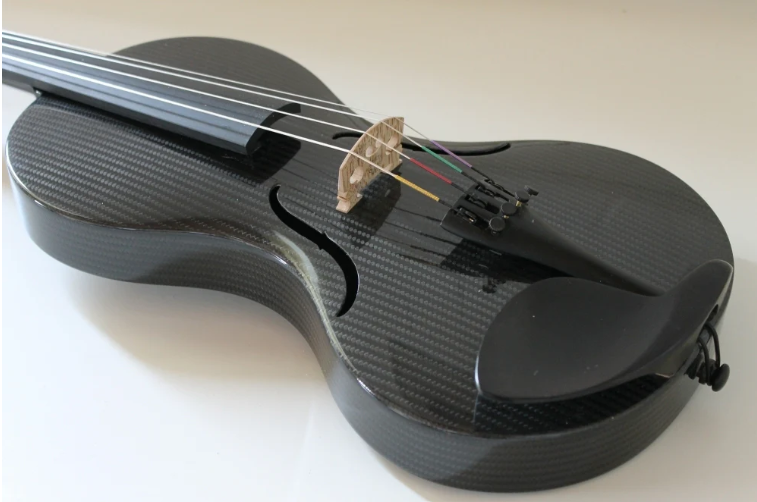
In string instruments, carbon composites are used not because of a "carbon fashion" but because of structural stability. Carbon-composite violins, violas and cellos are less sensitive to temperature and humidity, tolerate transport better and retain predictable geometry. For acoustics this has a direct consequence: the stiffness, mass and damping of the structure affect the instrument's response.
For an article about PA CF, this example should be read as an engineering analogy. Not every carbon instrument is a PA CF part. But the principle itself is useful: carbon fiber is interesting where the structure must remain light, stiff and stable under conditions that create a risk of changing behavior for wood, metal or an unfilled polymer.
PA6 CF in 3D printing, drones and robotics
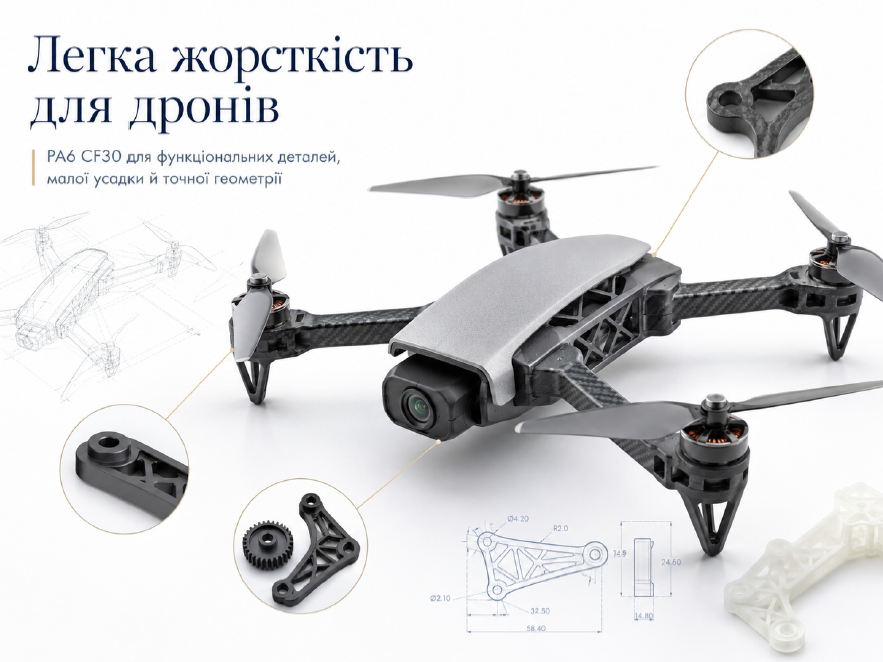
In functional prototyping, PA6 with short carbon fiber is interesting because it brings 3D printing closer to real load-bearing parts. In one study of CF/PA6 filament, short fibers less than 300 µm long were used; the optimal filament production conditions included a melt temperature of 270 °C, a screw speed of 50 rpm and a pulling speed of 5 cm/s.
For custom drones, robotics and tooling, this opens a niche for quickly verifying stiff functional parts with low shrinkage and relatively stable geometry. Printed PA CF cannot automatically be equated with a molded compound: fiber orientation, interlayer adhesion, porosity and printing parameters form their own risk map.
Where PA CF is technically justified
The techno-economic boundary: PA CF, PA GF and PPA GF50
The main limitation of PA CF often lies not only in technology but also in economics. Carbon-fiber-filled polyamides carry a higher price, are harder to source and compete strongly with glass-filled PA and PPA. In many parts, PA GF or PPA GF can provide sufficient stiffness, stability and service life at a lower cost.
In certain structural tasks, PPA GF50 can be a rational alternative to PA CF. It usually loses on mass and specific stiffness, but it can deliver high stability, heat resistance and reliability at a lower cost. If grams are not decisive, this alternative can be the stronger one for the product.
| Task | Stronger starting candidate | Comment |
|---|---|---|
| Minimize mass | PA CF | Especially for moving or inertia-sensitive assemblies. |
| High stiffness at a lower price | PA GF / PPA GF | Check before switching to CF. |
| Heat resistance and stability where mass is not critical | PPA GF50 | Can be economically stronger. |
| ESD behavior | PA CF | Only if conductivity does not conflict with the design. |
| Electrical insulation | PA GF or dedicated electrical grades | CF can create unwanted conductivity. |
Anisotropy, weld lines and impact behavior
In molded PA CF, fibers orient along the melt flow. As a result, properties along the flow and across the flow can differ. In thin, long or flat parts this translates into differential shrinkage, internal stresses and warpage. For the design engineer it is important not only to choose the material, but also to understand how it will fill the mold.
Weld lines require separate attention. Scientific work on PA-CF composites shows that in the weld line zone, fibers can arrange themselves in a way that reduces their reinforcing effect. For housings with holes, snap-fits, bosses, brackets and thin ribs, this can be more critical than the difference in modulus measured on a standard specimen.
Impact behavior also cannot be reduced to high stiffness. Carbon fiber can raise the modulus and stability, but in some systems it reduces the deformation margin or increases sensitivity to stress concentrators. For parts exposed to drops, snap-fits, thin ribs or sharp thickness transitions, comparing TDS sheets is not a sufficient check.
Contact with metals and the risk of galvanic corrosion
A separate PA CF risk relates to contact between carbon fiber and metals. Carbon fiber is an electrically conductive component. If a PA CF part is in contact with a metal fastener, housing or insert in a humid or electrochemically active environment, the possibility of galvanic corrosion of the metal must be assessed.
This factor is especially important for materials with a high CF content, for example CF30, CF50 or long-fiber compositions. In such cases the question goes beyond stiffness. The whole system must be considered: polymer, metal, moisture, electrical contact, coatings, contact geometry and operating conditions.
For Material Wizard this is one example of why PA CF cannot be assessed in isolation. A material can have strong mechanical properties yet be risky in a specific assembly because of its interaction with other materials.
When PA CF may be an excessive or risky choice
PA GF or PPA GF already meets the requirements
Switching to CF can increase the budget without a proportional technical gain.
Mass is not critical
PPA GF50 or another GF compound can provide sufficient stability at a lower cost.
Electrical insulation is required
The conductivity of CF can conflict with the function of the part.
Contact with metal in a humid environment
The galvanic couple and the protection of the metal must be assessed.
The dominant load is impact
A high modulus can matter less than impact strength and behavior near stress concentrators.
Complex geometry with weld lines
Local weakness can reduce the benefit of high datasheet properties.
Production is not ready for an abrasive filler
Wear of the screw, barrel, nozzle and mold becomes part of the material cost.
A decorative surface or light color is required
CF compounds usually have a technical black appearance and limited freedom of coloring.
How Material Wizard approaches such tasks
In material selection practice, a request often starts with a specific designation: PA66 CF30, PA6 CF30 or PPA CF. This is a convenient starting point, but not the final decision. Material Wizard first clarifies which property is critical: stiffness, mass, temperature, ESD, dimensional stability, chemical resistance, impact behavior or the economics of series production.
Alternatives are then evaluated. If high stiffness is needed without a critical mass constraint, PPA GF50 or another glass-filled material can be a strong option. If reduced inertia, thermal expansion control or an ESD function is required, PA CF becomes considerably more attractive. If the geometry includes snap-fits, thin ribs or weld lines, checking impact behavior and local zones becomes mandatory.
For tasks that require a combination of high stiffness and better impact behavior, Material Wizard can consider specially modified compositions or alternative material solutions. The specific approach depends on the part geometry, operating conditions and the economic limits of the project.
Practical Material Wizard solutions in the PA CF segment
This section works as a bridge from the engineering logic of the article to specific materials. Material Wizard carbon-fiber-filled polyamides differ by more than CF percentage. The key roles are played by the matrix, the type of reinforcement, the stiffness level, the expected geometric stability, the effect of moisture, the operating temperature and the economics of the part.
Full PA CF section: carbon-fiber-filled polyamides from Material Wizard
If the part involves metal contact, thin ribs, weld lines or impact loading, grade selection should preferably start with an analysis of the assembly rather than the filler percentage.
High-temperature and low-moisture PA CF solutions
These materials are worth considering for parts where standard PA6 or PA66 is approaching its limit in temperature, dimensional stability or moisture sensitivity.
Examid PPA CF33
For parts with elevated operating temperature, high stiffness, lower thermal expansion and strict geometry requirements.
Examid PA610 CF30
For assemblies that need the stiffness of PA CF while reducing the influence of moisture compared with classic PA6 or PA66.
Examid PA66 CF: structural stiffness at different filler levels
The PA66 CF series suits technical parts under mechanical and thermal load. Moving from CF20 to CF40 increases stiffness, but at the same time raises the demands on molding, geometry, weld lines and impact behavior assessment.
Examid PA66 CF20
A rational option for increasing the stiffness of PA66 without moving to the stiffest and more abrasive CF system.
Examid PA66 CF30
For housings, brackets, mating zones and critical structural elements where specific stiffness and dimensional stability matter.
Examid PA66 CF40
For tasks focused on minimal deformation and high stiffness. Requires careful checking of weld lines, stress concentrators and molding feasibility.
PA6 CF and hybrid GF/CF compositions
This group is useful where stiffness and weight control are needed, but a full switch to a highly filled CF grade may be excessive in cost or process risk.
Examid PA6 CF30
For stiff technical parts, functional elements, prototypes, drones and robotics, where low mass, stiffness and shrinkage control matter.
Examid PA6 GF20CF10
Hybrid reinforcement for tasks that need stiffness above the standard GF level, where a fully carbon solution may be economically excessive.
Examid PA66 CFGF30
Hybrid reinforcement for structural parts that need an intermediate logic between PA66 GF and PA66 CF in stiffness, stability and economics.
How to read material pages before selection
The CF percentage does not describe the material completely. For the process and design engineer, what matters is the matrix, flow, residual fiber length after compounding, interfacial adhesion, dispersion, stabilization and the expected fiber orientation in the specific mold.
Do not start from CF30 alone
Identical labeling does not guarantee identical behavior in the part, especially near the gate, weld lines or thin ribs.
Compare with PA GF and PPA GF
If mass is not critical, a glass-filled alternative can be technically sufficient and cheaper.
Assess contact with metal
For a humid or electrochemically active environment, the risk of galvanic corrosion must be checked.
Check the geometry
Snap-fits, holes, sharp thickness transitions and weld lines can change the result more than the difference between two TDS.
Practical conclusion
PA CF has high engineering value when the part genuinely requires low mass, high specific stiffness, lower thermal expansion, ESD behavior or specific stability in precise geometry. In these tasks, carbon fiber can deliver an advantage that is difficult to obtain with ordinary glass reinforcement.
In many other cases, PA GF, PPA GF or PPA GF50 can be technically sufficient and economically stronger. A more expensive material does not always mean a better product. For Material Wizard, the value of a material is determined by how it performs in a specific part, on specific equipment and within the specific economics of production.
PA CF should be treated as an engineering tool. Its selection must be confirmed by the function of the part, the operating conditions, the design risks and the real alternatives.