Products and services
White masterbatch for films TiO₂ 70%
Description
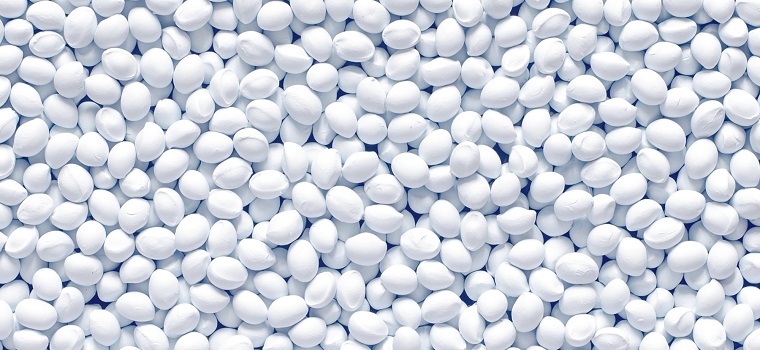
High-loading white masterbatch based on rutile TiO₂ — 70% active pigment in a polyethylene carrier matrix, with no fillers. A premium grade for thin packaging films (15-40 µm) where maximum opacity is required at a minimum dosage (1.5-3.5%). High pigment purity and optimal particle size ensure rich whiteness without reducing film strength. An analogue of the Tosaf WPE71 series and Schulman Polybatch P8555 for high-loading white MB.
Key properties
- TiO₂ concentration 70% in a PE carrier — no CaCO₃ or other fillers
- Minimum dosage 1.5-3.5% — low let-down ratios
- High opacity on thin films of 15-40 µm
- No reduction in film strength thanks to high pigment purity
- Good dispersion — suitable for blown and cast extrusion
- Stable processing over a wide temperature window
Applications
Thin packaging films. Hygiene packaging, dairy product bags, shrink film, snack packaging — wherever maximum opacity is needed at minimum thickness.
Multilayer food contact films. White layer in 3/5/7-layer coex films for packaging dairy, meat and frozen products. Compliance with Regulation (EU) 10/2011 for plastic packaging — per separate batch specification.
Premixes for compounders. A cost-effective way to add TiO₂ to PE, PP and PA compounds — dust-free with accurate dosing.
Lamination film. White layers of laminated structures (BOPP, BOPET) for printed labels.
Regulatory notes
TiO₂ as food additive E171 has been banned in the EU since 7 August 2022 (Regulation (EU) 2022/63). The restriction applies to food products, not packaging films. The use of TiO₂ as a pigment in plastic packaging remains permitted under Regulation (EU) 10/2011, subject to the Specific Migration Limit. For food contact applications, request a Declaration of Compliance (DoC).