Products and services
Ultraplen® PP GF30-530 — Glass-Filled Polypropylene, 30% GF
Description
Ultraplen® 530 — 30 % glass-fiber-filled polypropylene from Material Wizard. An injection-molding compound based on a polypropylene matrix, reinforced with 30 % chopped glass fiber and a compatibilizer (MAH-PP). Developed as a cost-effective engineering alternative to glass-filled PA GF for parts that require structural stiffness, dimensional stability in humid environments and corrosion resistance — at one third of the cost and 1.5 times lower density.
Why Ultraplen® 530 instead of PA66 GF30
- Stability in water: PP+GF does not absorb moisture (<0.05 % in 24 h) — modulus and dimensions remain stable without drying straight after molding. PA66 GF30 loses up to 30 % of its modulus at moisture saturation and requires conditioning.
- Lower density: 1.12 g/cm³ vs 1.35 g/cm³ for PA66 GF30 — part weight savings of ~15 %.
- Raw material cost: 2.5–3.5 times lower than imported PA66 GF30 at comparable stiffness for parts operating below 100 °C.
- Chemical resistance: resistant to dilute acids, alkalis and aqueous salt solutions — outperforms PA in aggressive water storage and transport environments.
Advantages
- Structural stiffness with a 6–7 GPa modulus at low density — high specific modulus
- Dimensional stability under high humidity and in contact with water
- Low creep tendency at moderate temperatures (up to 80 °C continuous)
- Good chemical resistance to oils, gasoline, aqueous salt solutions, dilute acids and alkalis
- Compatible with standard PP injection-molding tooling without modification
- Low VOC content — compliance with EU 10/2011 for food-contact applications
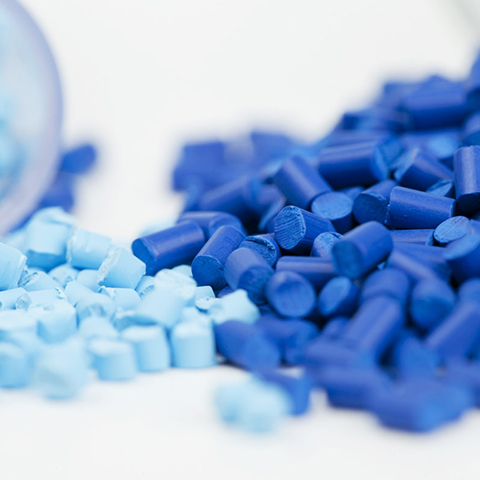
- Color matching to any RAL/Pantone shade (minimum base batch 25 kg)
Limitations — honestly
- Not for temperatures >100 °C continuous — for under-hood applications or hot liquids choose PA66 GF, PPS or PPA
- Shrinkage anisotropy along fiber flow lines — requires well-considered gate placement and adequate wall thickness (minimum 1.5 mm)
- Visible fiber on the surface of thin-walled parts (white streaks) — cosmetic applications require surface finishing (texture / post-processing / painting)
- The base grade is rated UL 94 HB — for V-2 / V-0 switch to Ultraplen® 600 (V-2) or combined FR-PA
- Lower toughness at -20 °C than unfilled PP — cold-climate use requires modification (EPDM cap or impact modifier)
- UV-unstable in the base formulation — a HALS package is added for outdoor use (optional)
Target applications
Water supply and sanitary equipment: cold-water pump housings, impellers, fittings, filter housings, water meter components, mounting brackets for piping.
Household appliances: internal structural parts of washing machines and dishwashers (where there is no contact with boiling water), fan housings, cooker hood bases, food processor components.
Industry: industrial fan impellers, pump housings for aggressive liquids (at up to 80 °C), technical covers, conveyor mounting elements.
Automotive (interior and cabin): ventilation system brackets, trim holders, air vent housings, cabin hardware components.
Agriculture: fertilizer dispenser housings, irrigation system fittings, greenhouse equipment components, fasteners.
Global equivalents
Parametrically comparable PP GF30 compounds: LyondellBasell Hostacom G3 R05, SABIC Stamax 30YK270E (long-fiber counterpart), Borealis Borstar® BJ368MO, RTP 100 Series 30 % GF, Mitsubishi Tafmer™ Premier. Ultraplen® 530 is offered as a localized alternative with flexibility in minimum batch size (from 25 kg), color, MFR and availability of special additives.
The stated values are measured using in-house methods close to the corresponding ISO and GOST standards. The information is provided for reference only and does not constitute an official technical data sheet for a batch. Please request the TDS and MSDS for the specific batch before industrial use.