Products and services
Polysulfone
Description
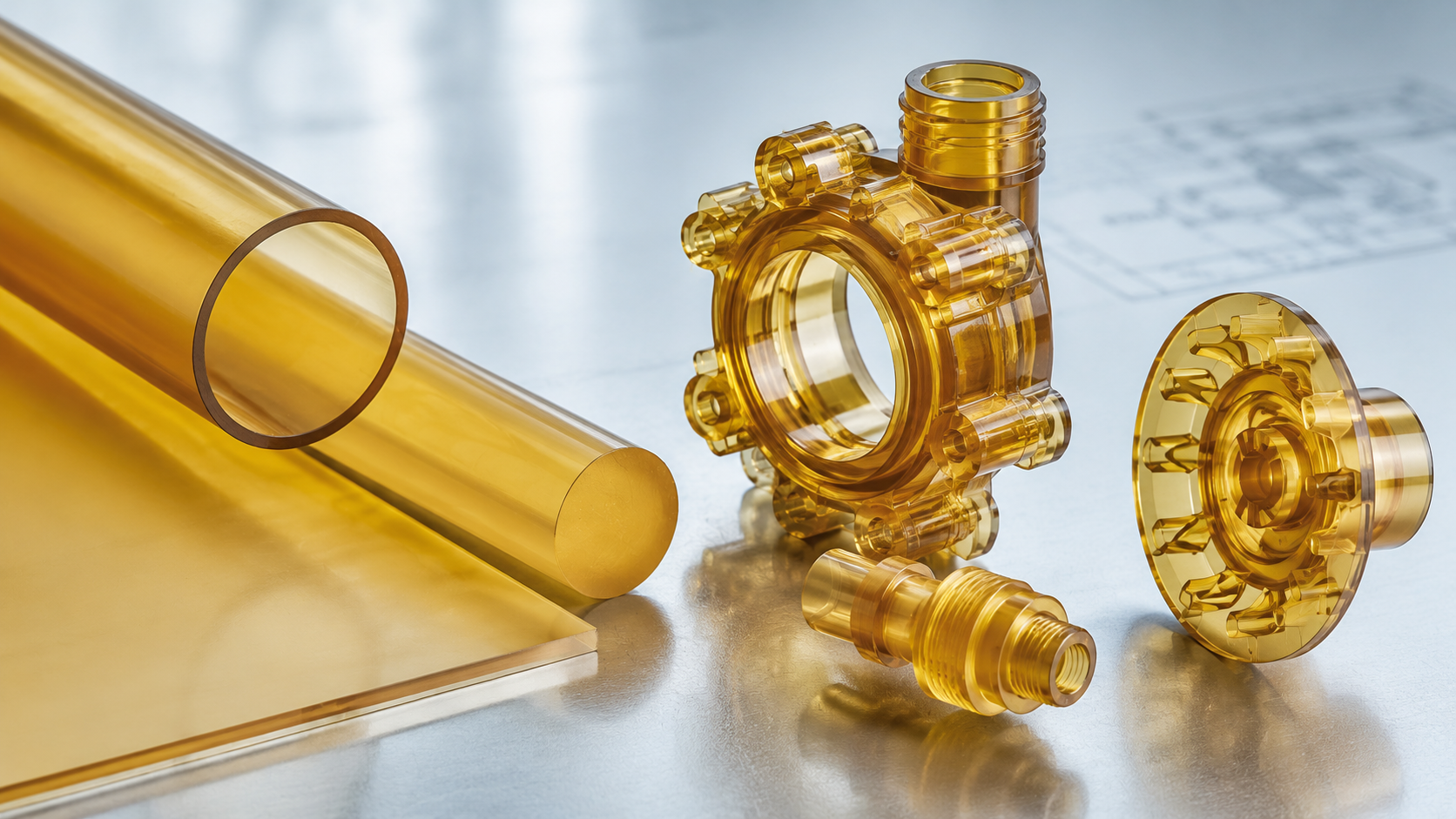
Polysulfone (PSU) is a high-performance amorphous transparent thermoplastic with a characteristic light-yellow opalescence. It belongs to the sulfone polymer family (together with PESU — polyethersulfone — and PPSU — polyphenylsulfone). Its molecular structure, with the sulfone group —SO₂— between aromatic rings, provides high heat resistance, exceptional hydrolytic stability and low moisture absorption.
Compared with polycarbonate (PC), PSU withstands hot water and steam without degradation (PC begins to hydrolyze at 80 °C and above); its service temperature is 30–40 °C higher; and its resistance to detergents and autoclaving is significantly better. PSU costs 4–6 times more than PC, but this pays off where PC cannot withstand the service conditions.
Typical parameters: density 1.24 g/cm³, Tg ≈ 185 °C, HDT/A ≈ 174 °C (ISO 75-2, 1.8 MPa), continuous service temperature 150 °C (short-term up to 175 °C), tensile strength ~70 MPa, tensile modulus ~2.5 GPa, water absorption ~0.3 % (24 h). Light transmission ~88 % (opalescent transparency with a light-yellow tint).
Key advantages
- Continuous service temperature 150 °C, Tg 185 °C — markedly higher than PC (Tg 145 °C)
- Hydrolytic stability: >1000 hours in boiling water/steam without property loss — replaces brass in pressurized hot-water systems
- Sterilization: autoclave (>1000 cycles at 134 °C), steam, gamma, ETO; unlike standard PC, it does not yellow significantly under UV exposure
- Transparency ~88 % — enables visual process monitoring in medical and pharmaceutical equipment
- Resistance to chlorinated hot water, detergents, dilute acids and alkalis
- BPA-free — no bisphenol A migration (important for food and baby products)
- Low creep under sustained load at elevated temperatures
- Good electrical insulation properties, stable across temperature and humidity ranges
- Colorability and secondary machinability of semi-finished stock (sheets, rods)
Applications
- Medical equipment for repeated sterilization: sterilization containers and trays, dosing device housings, anesthesia equipment components, dialysis membrane modules
- Hot-water plumbing fittings: boiler system manifolds, valve components, hot-water dispenser fittings — a direct corrosion-free replacement for brass (nickel)
- Filtration and membrane processes: micro- and ultrafiltration membranes (UF/MF), water-treatment membrane modules, bioreactors — the base polymer for Solvay/Sumitomo asymmetric membranes
- Food and baby products: new-generation baby bottles (BPA-free), juicer and blender components, reusable containers for hot drinks
- High-temperature electrical engineering: transformer housings, coil insulators, automotive lighting components, connectors for high-temperature soldering
- Dentistry and laboratory equipment: reusable surgical instruments, analytical cuvettes, components of sterilizable analyzers
- Aviation: cabin (non-structural) and interior components meeting FAR 25.853 and NBS smoke density requirements
Global equivalents: Solvay Udel® P-1700 NT (the original PSU grade, developed by Union Carbide / Amoco / Solvay in the 1960s), BASF Ultrason® S 2010, Quadrant Polypenco® (semi-finished stock), Jiada PSU. For applications above 180 °C, consider PESU (polyethersulfone) or PPSU (polyphenylsulfone) — see the corresponding catalog categories.
The stated values are measured by in-house methods close to the corresponding ISO and GOST standards. This information is provided for reference only and is not an official batch data sheet. Before industrial use, please request the TDS and MSDS for the specific batch.