Products and services
Polycarbonate Makrolon® ET3113 extrusion sheet grade, UV-stabilized
About the product
Makrolon® ET3113 from Covestro is a high-viscosity, impact-resistant and UV-stabilized extrusion polycarbonate (PC). The designation ET = Extrusion Transparent: high molecular weight and a low MVR of ~6 cm³/10 min (300 °C / 1.2 kg) provide melt stability during sheet extrusion — solid sheet, multiwall sheet and corrugated sheet. This is a feedstock material for sheet semi-finished products, not an injection-molding grade.
How ET3113 differs from other Makrolon series
- ET series (Extrusion Transparent) — high viscosity for complex extrusion profiles and sheet, UV stabilization for outdoor applications.
- LQ series (Low viscosity) — injection molding, optical lenses, transparent electronics housings. If you need spectacle/ophthalmic lenses, that is LQ or Apec, not ET.
- OD series (Optical Disc) — a highly specialized grade for precision optical media with minimal birefringence.
- DP/RX series — medical/food-contact grades for bottles and containers.
Advantages
- Extrusion stability with complex profiles (multiwall, corrugated sheet with thin webs)
- High impact strength over a wide temperature range (-40 … +100 °C)
- Transparency up to 88 %, with the option of thermoforming the sheet into finished parts
- UV stabilization for architectural and outdoor applications
- Compatibility with standard Covestro/SABIC/Plaskolite extrusion tooling
- Suitable for lamination, hardcoat application and co-extrusion with PMMA for improved scratch resistance
Limitations — stated honestly
- Not an injection-molding grade. The high viscosity makes quality injection moulding of thin-walled optical parts impossible — for eyewear, helmets and housings use Makrolon LQ or Apec.
- Not for ophthalmic lenses or eyewear. These products require OD/LQ grades with controlled birefringence and precision injection.
- Scratch-sensitive — for architectural and safety applications a hardcoat (Margard type) or lamination with PMMA is recommended
- Stress cracking on contact with aliphatic hydrocarbons, ketones and alkalis — incompatible with solvents
- Yellowing index in the absence of proper UV protection — the declared ET3113 package typically delivers 5-7 years outdoors without significant yellowing
- Moisture-sensitive before processing — drying at 120 °C for 3-4 h to <0.02 %
Target applications (extruded sheet)
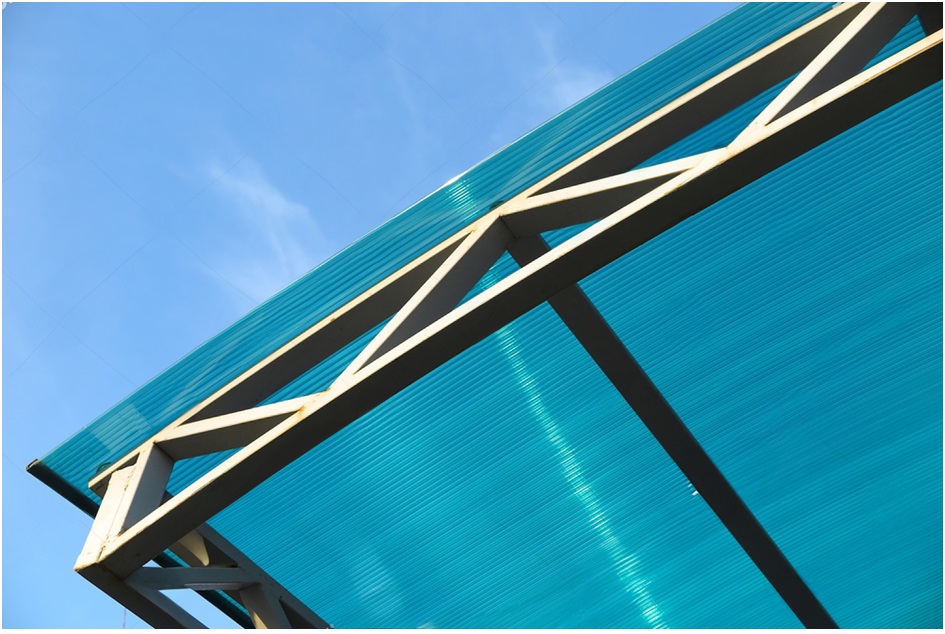
Architecture and construction: transparent roofs and canopies (multiwall sheet), skylights and roof lights, partitions in shopping centers, greenhouses and cold frames with UV protection, noise barriers along highways.
Industry and safety: protective guards for machine tools and automated lines, transparent conveyor shields, bullet-resistant multilayer laminates (as the PC component), riot shields via sheet thermoforming.
Transport: glazing for public transport (trams, buses), protective partitions in cabs, interior trim elements.
Advertising and POS: light-box front panels, vending machine screens, transparent displays and showcases.
All the listed applications use sheet as the starting stock with subsequent thermoforming or CNC machining, not injection moulding.
Global equivalents
Parametrically comparable extrusion PC sheet products: SABIC LEXAN™ Margard MR10/MR5E (UV-coated solid sheet), Plaskolite OPTIX™ SG (general purpose), Arla Plast Arla™ LSG (UV-stab outdoor), 3A Composites POLYGAL™ Multiwall (multiwall sheet for greenhouses), Trinseo CALIBRE™ 200-22 (extrusion grade). For comparison: optical/lens grades are Makrolon® LQ2647, Bayer Apec™ 1745, Trinseo CALIBRE™ 2080 — an entirely different product class.
The stated values are measured by in-house methods close to the corresponding ISO and GOST standards. This information is provided for reference only and is not an official batch data sheet. Before industrial use, please request the Covestro TDS and MSDS for the specific batch.