
Товары и услуги

Polyoxymethylene Exablend POM 1900

Description


Exablend POM 1900 is a polyacetal homopolymer (POM-H) with improved molding properties, containing a processing release agent and a built-in lubricant. It combines the highest stiffness among polyacetals, a low coefficient of friction and precise molding. Weather-resistant, it holds its shape under long-term loads. An analog of DuPont Delrin 500P and 100P in applications requiring a homopolymer (POM-H) structure with higher crystallinity.

Key properties

  • POM-H homopolymer — higher crystallinity and HDT compared with POM-C
  • The highest stiffness and Young's modulus among polyacetals
  • Built-in release agent and lubricant — precise molding without additional additives
  • Low coefficient of friction (increased PV value)
  • Low moisture absorption (<0.25 % in 24 h)
  • Weather-resistant, shape recovery under load
  • High fatigue strength — for dynamic parts

Applications

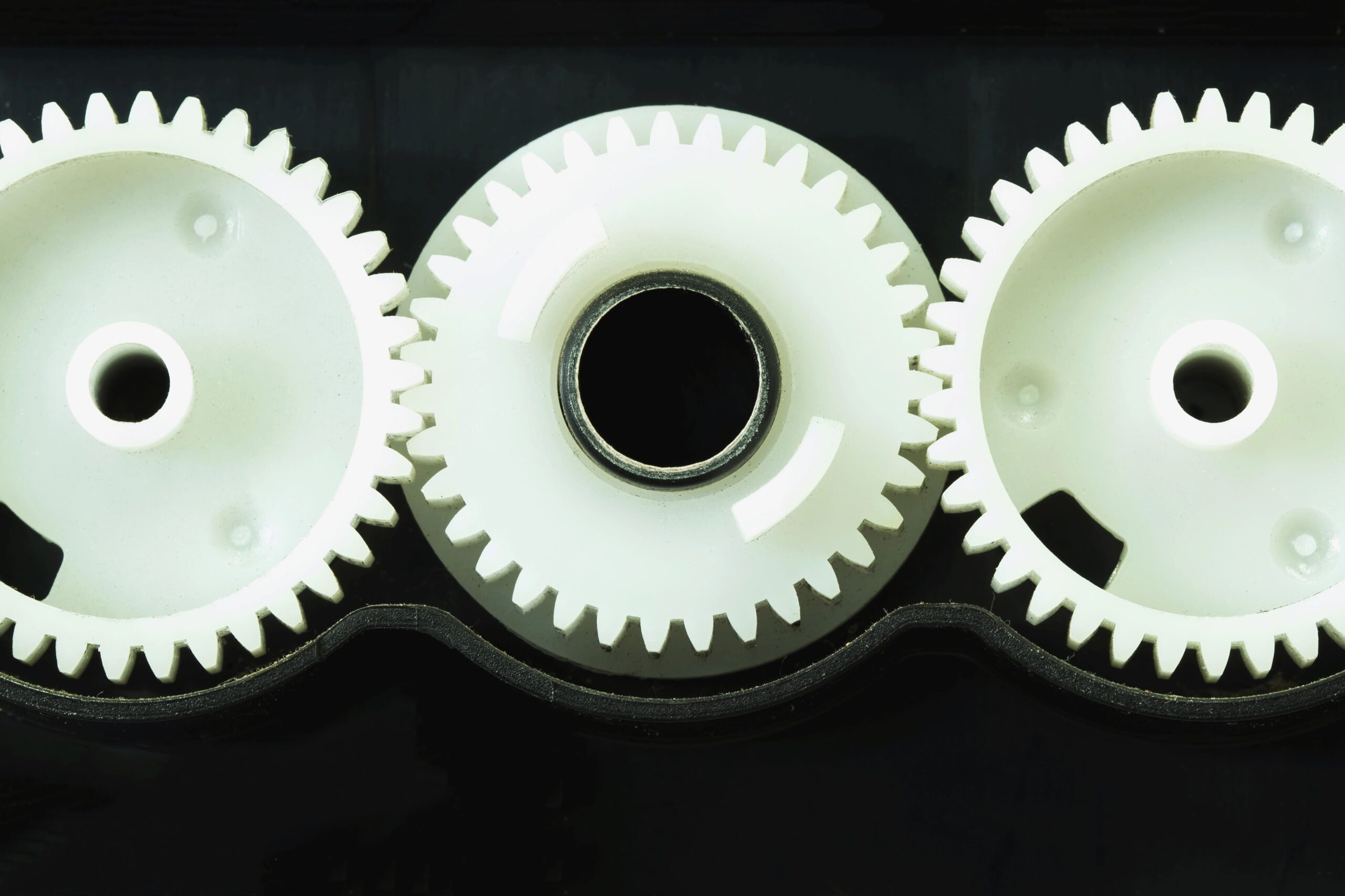
Precision gears and drives. Gear wheels for household appliances, automotive and medical devices — geometric accuracy and wear resistance.

Latches, clips, buttons. Quick-release connections and fastening clips — repeated deformation without loss of shape.

Automotive fuel systems. Pump housings, valves, bushings — resistance to gasoline/diesel/ATF.

Plumbing. Mixer bodies, cartridges, connections — hot water resistance.

Furniture hardware. Precision locks, hinges and hardware for sliding mechanisms.
Polyoxymethylene Exablend POM 1900
Property
Unit
Value
Physical properties:
Supply form
Pellets
Pellet size
mm
2…6
Density
g/cm³
1.42 (ISO 1183-1)
Water absorption (saturation, 23 °C)
%
0.5 (ISO 62)
Rheological properties:
Melt flow rate (MFR, 200 °C / 2.16 kg)
g/10 min
25 (ISO 1133-1)
Mold shrinkage (flow direction)
%
1.8 (ISO 294-4)
Mold shrinkage (transverse direction)
%
1.7 (ISO 294-4)
Mechanical properties:
Tensile stress at yield (conditioned)
MPa
70 (ISO 527-2)
Tensile stress at yield (dry)
MPa
70 (ISO 527-2)
Tensile strength (10-year aging)
MPa
50 (ISO 527-2)
Charpy impact strength (unnotched, 23 °C)
kJ/m²
>200 (ISO 179-1/1eU)
Charpy impact strength (unnotched, −40 °C)
kJ/m²
150 (ISO 179-1/1eU)
Charpy impact strength (unnotched, moisture-saturated, 23 °C)
kJ/m²
>200 (ISO 179-1/1eU)
Charpy impact strength (unnotched, 10-year aging, 23 °C)
kJ/m²
80 (ISO 179-1/1eU)
Charpy impact strength (notched, 23 °C)
kJ/m²
5 (ISO 179-1/1eA)
Charpy impact strength (notched, −40 °C)
kJ/m²
5 (ISO 179-1/1eA)
Ball indentation hardness (conditioned)
MPa
150 (ISO 2039-1)
Ball indentation hardness (dry)
MPa
150 (ISO 2039-1)
Flexural strength
MPa
90 (ISO 178)
Elongation at break
%
25 (ISO 527-2)
Compression modulus (dry)
GPa
2.9 (ISO 604)
Flexural modulus (dry)
GPa
2.7 (ISO 178)
Thermal properties:
Melting temperature
°C
178 (ISO 11357-3)
Heat deflection temperature (1.8 MPa)
°C
95 (ISO 75-2)
Heat deflection temperature (0.45 MPa)
°C
160 (ISO 75-2)
Coefficient of linear thermal expansion, longitudinal
µm/(m·K)
100 (ISO 11359-2)
Coefficient of linear thermal expansion, transverse
µm/(m·K)
100 (ISO 11359-2)
Flammability
class
HB (UL 94)
Oxygen index
%
23 (ISO 4589-2)
Electrical properties:
Dielectric strength
kV/mm
32 (IEC 60243-1)
Volume resistivity
Ω·m
10^12 (IEC 62631-3-1)
Surface resistivity
Ω
10^15 (IEC 62631-3-2)
Comparative tracking index (CTI)
V
600 (IEC 60112)
*
Typical data for this polymer class, for reference.
Указанные показатели измеряются по внутренним методикам, близким к соответствующим ISO, ГОСТ Информация носит ознакомительный характер, рекомендуем использовать техническую информацию после согласования с поставщиком и подписания нормативно-технической спецификации