Products and services
Exablend® PC-900 — transparent injection molding polycarbonate UL 94 V-2
Description
Exablend® PC 900 is a transparent injection molding polycarbonate rated UL 94 V-2 from Material Wizard. A standard medium-flow injection grade of polycarbonate for precision thin-walled parts with high light transmission, impact strength and basic flame retardancy. The base formulation without UV stabilization is intended for indoor use. For outdoor applications, the UV-stabilized modification Exablend® PC 901 is available.
Exablend® PC series — how to choose a grade
- Exablend® PC 900 — base transparent V-2 for indoor use (this product card)
- Exablend® PC 901 — UV-stabilized transparent V-2 for outdoor use
- Exablend® PC GF 930 — glass-filled PC GF30 for structural parts with increased stiffness and dimensional stability
- Exablend® PC/ABS 965 — PC+ABS blend for parts with complex geometry and reduced water absorption
Advantages
- High impact strength over a wide temperature range (-40 … +120 °C) — characteristic of the PC class
- Light transmission of ~88 % with minimal haze — for optically clear housings and lenses
- V-2 out of the box without loss of transparency (a typical problem of FR additives in PC)
- Good flow for thin-walled housings of 1.0–1.5 mm
- Stable dimensions under humidity changes (water absorption 0.15 % vs 1.5–3 % for PA)
- Compatible with hard-coat coatings (Margard type, AR) for anti-scratch requirements
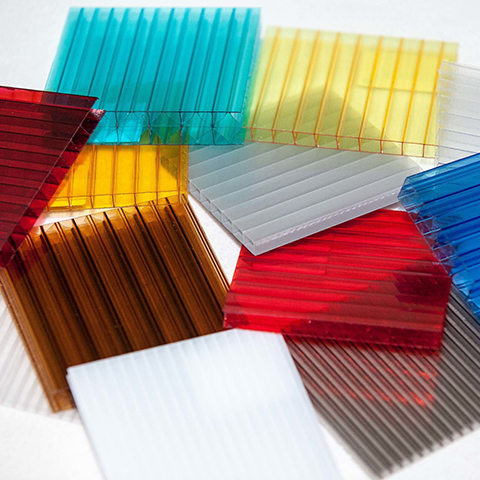
- Can be tinted in any transparent shades (transparent tinted) while retaining V-2
Limitations — honestly
- V-2, not V-0. V-0 requires dedicated FR grades with minimal change in transparency (made to order)
- Not for outdoor use in the base formulation — pure PC yellows under UV within 6–12 months. For outdoor use choose Exablend® PC 901 or third-party UV-coated solutions
- Sensitive to stress cracking in contact with aliphatic hydrocarbons, ketones, acetone and alkalis — incompatible with cleaning solvents
- The surface is scratch-sensitive — cosmetic applications require a hard coat (AR/MAR)
- Mandatory drying before processing: 120 °C, 3–4 h down to <0.02 % moisture — otherwise visible silver streaks appear on the surface
- High processing temperature (melt 280–310 °C) — hot-runner tooling is preferable
- Light transmission drops by 5–8 % after 1000 h of UV exposure — transparent outdoor applications require a stabilized grade
Target applications
Lighting: diffusers for household and office LED luminaires, housings of transparent decorative lamps, elements of flashlights and portable light sources.
Electronics: transparent housings of handheld devices, display windows (with hard coat), protective panels of instrument clusters, housings of USB devices and adapters.
Medical and laboratory equipment: equipment inspection windows, transparent protective screens, cuvettes and labware (USP Class VI compliance on request), elements of sterilizable housings.
Home appliances: transparent microwave doors / windows, baking equipment elements with visual monitoring, housings of blenders and food processors.
Industrial safety: protective machine guards (indoor), machine tool inspection windows, transparent conveyor guards.
Global counterparts
Parametrically comparable transparent injection molding PC V-2 grades: Covestro Makrolon® 2407 / 2607, SABIC LEXAN™ 121R / 144R, Trinseo CALIBRE™ 200-22, Mitsubishi Iupilon™ E-2000R, Teijin Panlite™ L-1225Y. Exablend® PC 900 is offered as a localized alternative with flexibility in batch size (from 25 kg), MFR, color and optional additives (UV, AR coating, IR-block).
The stated values are measured by internal methods close to the corresponding ISO and GOST standards. This information is for reference only and is not an official technical data sheet for a batch. Before industrial use, please request the TDS and MSDS for the specific batch.