
The engine bay is one of the harshest environments for an engineering plastic: a hot zone right next to the engine, contact with oils, fuel and antifreeze, thousands of heating-cooling cycles. The industry's classic answer for such applications is heat-stabilized glass-filled polyamide 66. Here is why PA66 GF30 in particular — and where the limits of its capabilities lie.
The problem: why the engine bay is dangerous for plastics
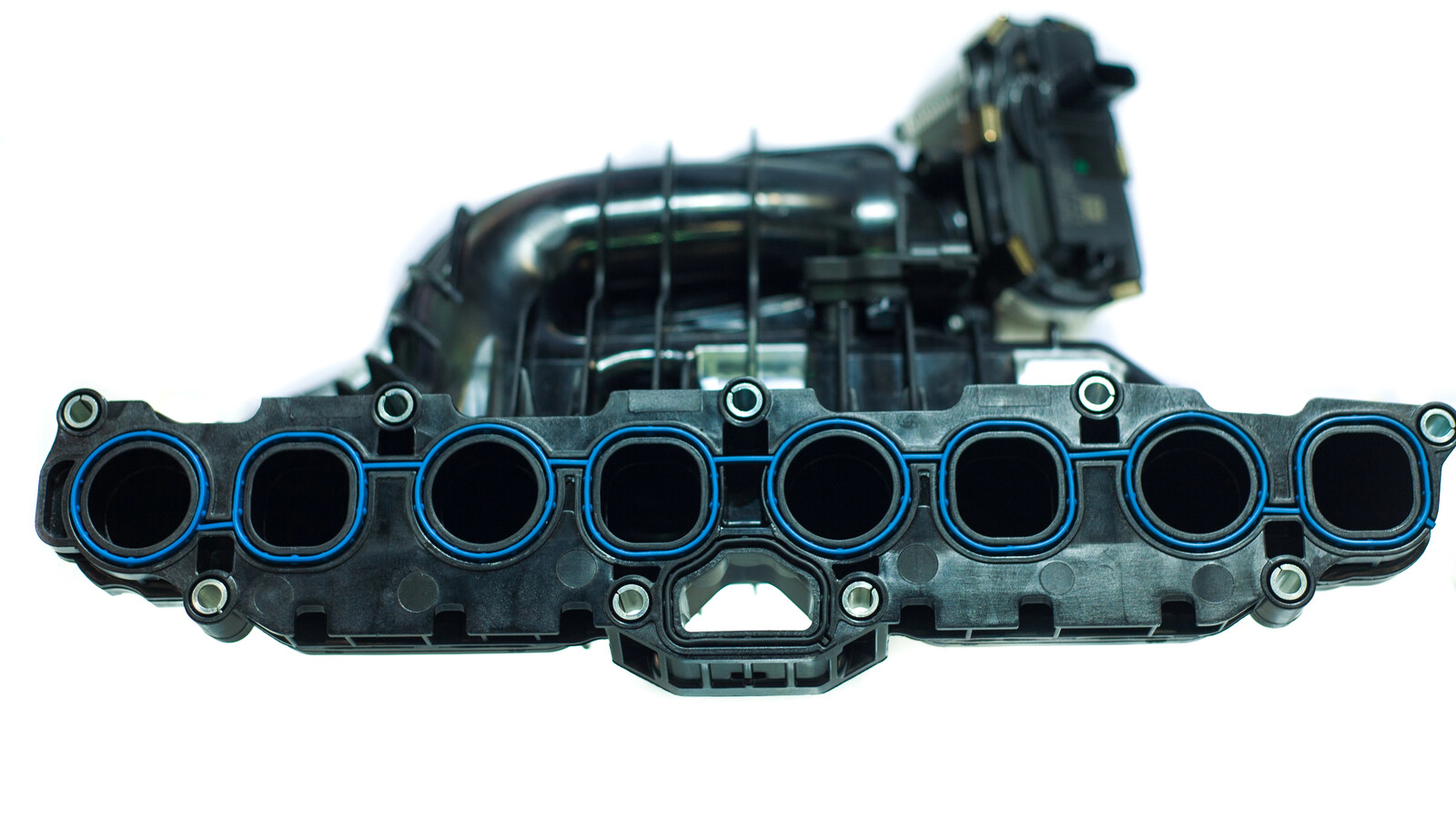
Brackets, housings, intake-tract pipes, covers, harness holders — all of these were historically made of metal, and today increasingly of reinforced polyamide. The part operates next to a hot engine, contacts service fluids and road salt, survives thousands of thermal cycles, and must not lose its shape or crack over the vehicle's entire service life. The design engineer faces a single question: which material will withstand long-term operation at elevated temperatures, will not "drift" from moisture, and will remain processable in series injection molding.
Technical requirements for the material
| Parameter | Indicative value | Why it is critical |
|---|---|---|
| Continuous service temperature | 130–180 °C | the part runs hot for years, not just for peak seconds |
| HDT at 1.8 MPa | with glass, significantly higher than base PA66 | shape retention under load in the heat |
| Elastic modulus | high stiffness thanks to 30 % GF | the bracket must not flex under vibration |
| Resistance to oils / fuel / antifreeze | high | constant contact with service fluids |
| Dimensional stability | controlled water absorption | fits and clearances must not drift |
| Resistance to thermal oxidation | heat-stabilized formulation | polyamide's main enemy in the heat is oxidation in air |
| Molding processability | good melt flow | complex geometry, thin ribs, series cycles |
Why glass-filled polyamide 66 in particular
Polyamide 66 inherently has a higher melting point (around 255–260 °C) and better heat resistance than PA6, which is why it is the default choice for hot zones. Adding 30 % short glass fibers sharply raises stiffness, strength and heat resistance under load: the HDT of reinforced PA66 approaches its melting point, whereas for unreinforced polyamide it is significantly lower. The glass fiber works here like rebar in concrete — the fiber network takes on the main mechanical work under load, while the polyamide matrix transfers and distributes the forces.
Heat stabilization — the key to real service life
In the engine bay, what decides is not only initial strength but the ability to retain it for years at temperature. That is why the key word is heat-stabilized. Ordinary polyamide in air at 130–180 °C gradually oxidizes and becomes brittle; dedicated heat stabilizers in the formulation slow this process down and determine the part's real service life. It is the heat-stabilization class, not just the glass percentage, that distinguishes an "automotive" PA66 GF30 grade from a general-industrial one. So when selecting a grade, the correct reference point is not "how much glass" but the confirmed temperature class and the service duration the formulation is designed for.
Examid® PA66 GF30 — the Material Wizard solution
Examid® PA66 GF30 is a glass-filled polyamide 66 in a heat-stabilized version, targeted specifically at critical parts operating for long periods at elevated temperatures. The grade is comparable to well-known automotive PA66 GF30 compounds but is produced to our own formulation. Switching from metal to heat-stabilized PA66 GF30 in non-critical load-bearing engine-bay components typically delivers a reduction in part weight, integration of several metal elements into a single molded part, and elimination of corrosion. Exact figures — service life, temperature class, tolerances — are always confirmed by testing on the specific geometry and in the real temperature cycle, because the behavior of reinforced polyamide depends on fiber orientation, wall thickness and molding conditions.
Examid® PA66 GF30Heat-stabilized glass-filled polyamide 66 · 130–180 °C continuous service · high stiffness · dimensional stabilityRequest supply terms →Alternatives in the MW range
| Grade | Base | Strong point | When to choose |
|---|---|---|---|
| Examid® PA66 GF30 | PA66 + 30 % GF, heat-stab. | heat resistance + stiffness | hot zones, 130–180 °C |
| Examid® PA6 GF30 | PA6 + 30 % GF | processability, melt flow | less hot parts, complex geometry |
| PPA (polyphthalamide) | semi-aromatic PA | extreme temperature | components near the hottest points |
If the part does not operate in the hottest zone, the more processable and affordable PA6 GF30 is often the rational choice — it flows better in a complex mold. When the temperature goes beyond the capabilities of aliphatic polyamides, the next step up is semi-aromatic polyphthalamide (PPA), which holds a significantly higher temperature class but is more difficult and expensive to process.
Examid® PA6 GF30Base glass-filled polyamide for series injection molding · good melt flow · stiffness · processabilityRequest supply terms →What to check before series launch
- Pellet moisture. Polyamide is hygroscopic; pellets must be dried to the recommended level before molding, otherwise strength drops and surface defects appear.
- Temperature class. Confirm that the selected grade is heat-stabilized specifically for your operating temperature and duration — this determines the real service life.
- Fiber orientation. The stiffness and shrinkage of reinforced polyamide are anisotropic; gate placement affects warpage and strength in the load direction.
- Dimensional stability after moisture uptake. Check the behavior of fits after conditioning to operating humidity, not only on freshly molded samples.
- Chemical compatibility. Verify resistance to the specific oils, fuel and antifreeze in contact with the part.
- Batch-to-batch consistency. Build verification of key properties from batch to batch into incoming inspection.
Expert breakdown: 5 questions to ask before selecting a grade
How is the heat-stabilization class linked to the part's real service life?
Directly. At 130–180 °C, service life is determined not by initial strength but by the rate of thermal oxidation in air. Heat stabilizers slow oxidation, and it is their class that sets how many thousands of hours the part will retain its properties. Focus on the confirmed temperature class and duration, not just the glass percentage.
Why is fiber orientation more important than the glass percentage itself?
Because reinforced polyamide is anisotropic: along the fibers, stiffness and strength are at their maximum; across them, significantly lower. In the weld-line zone the fibers lie across the flow, and strength there is at its lowest. That is why gate placement and rib design often decide more than a few extra percent of glass.
Which drying regime is critical before molding PA66 GF30?
Polyamide is hygroscopic, and moisture in the melt causes chain hydrolysis — an irreversible loss of molecular weight and strength. Pellets are dried in a desiccant dryer to the recommended moisture level before molding; the specific temperature and time are taken from the grade's TDS. Under-dried pellets produce silver streaks, bubbles and a drop in mechanical properties.
How to account for dimensional change after moisture uptake in precision fits?
Glass fiber reduces overall water absorption compared with unreinforced polyamide, but hygroscopicity remains, and dimensions grow slightly after conditioning. For critical fits, tolerances are specified with equilibrium moisture content in mind, and control measurements are made on conditioned samples rather than freshly molded ones.
When is PA66 GF30 no longer enough and it is time to move to PPA?
When the operating temperature consistently goes beyond the capabilities of aliphatic polyamides, or when particular dimensional accuracy and chemical resistance in the heat are required. Then the next step up is semi-aromatic polyphthalamide (PPA): it holds a significantly higher temperature class but is more difficult and expensive to process, so the switch must be justified by the actual requirements of the component.